
 Español

A data center doesn’t get the green light based on its technical specifications alone. Industry reality shows that for a project to be viable, it requires something equally decisive: the trust of the local community where it is built.
Technical approval and social license are two sides of the same coin. That is why at EHS Techniques we align the Integrated Environmental Permitting (AAI) process with community engagement, advancing both hand in hand through each phase of the RIBA Plan of Work design process.
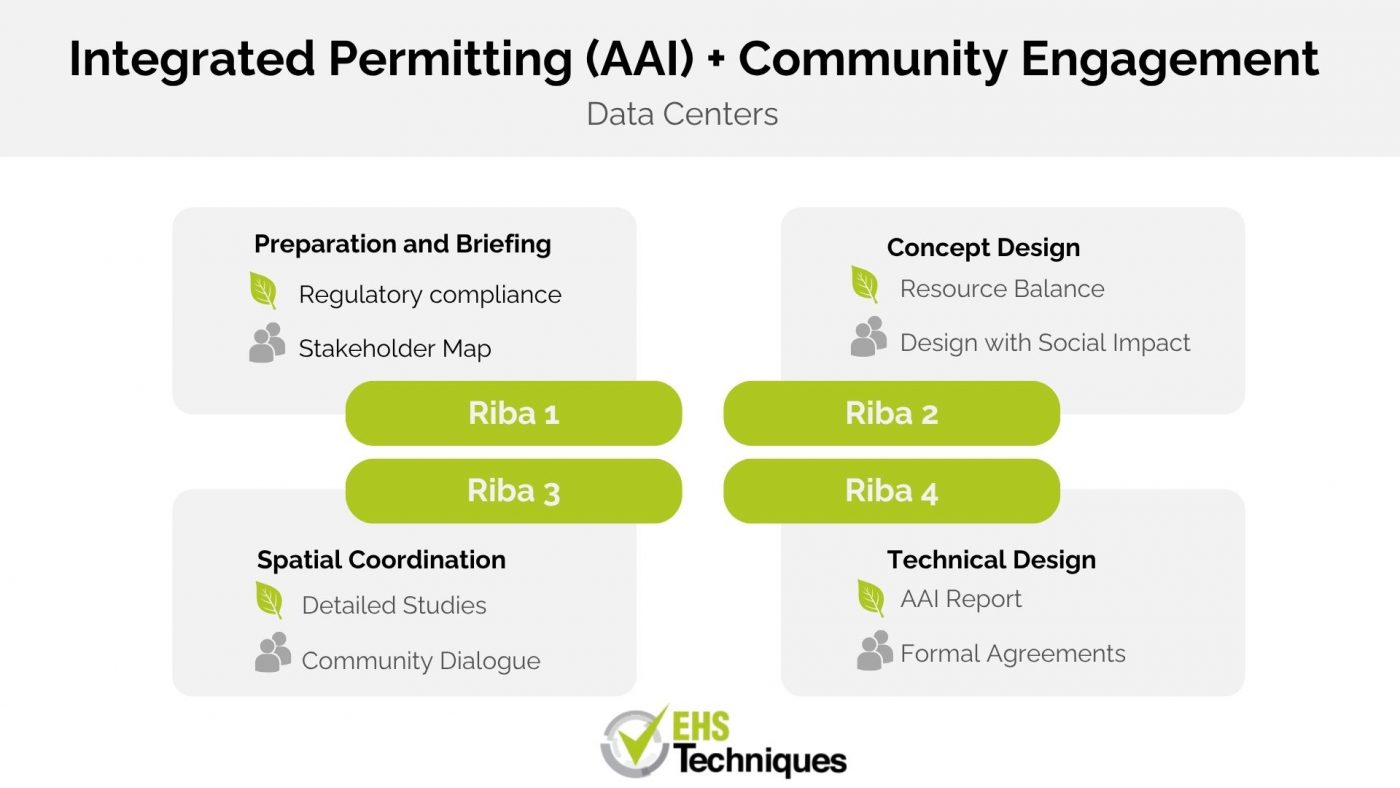
What exactly happens at each stage?
RIBA Stage 1 · Preparation and Briefing
Before design work begins, the focus is on reviewing environmental regulations to understand key compliance requirements. Simultaneously, local stakeholders, community groups, and institutions are identified to ensure open communication from day one.
RIBA Stage 2 · Concept Design
As the project takes shape on paper, engineers model the resource balance (such as water and energy) required for the facility. Concurrently, community feedback is gathered to ensure the initial design accounts for local social impact.
RIBA Stage 3 · Spatial Coordination
This stage focuses on technical detail. Comprehensive environmental studies are conducted as required by law to secure the Integrated Environmental Permit (AAI). Meanwhile, open, continuous communication is maintained with the local community, resolving queries and sharing information with stakeholders.
RIBA Stage 4 · Technical Design
With all engineering details finalized, the final Integrated Environmental Permit (AAI) report is drafted and submitted to the regulatory authorities. On the social front, this stage culminates in formal agreements with the local community, ensuring clear, transparent, written commitments for everyone’s peace of mind.
Projects done right from day one
Addressing environmental permits and community relations late in the process often leads to uncertainty, pushback, and project timeline delays.
When Integrated Environmental Permitting and community dialogue are carried out alongside data center design—rather than as an afterthought—projects move forward on much stronger footing, offering guarantees for developers and peace of mind for local residents. As a result, data center developments aren’t the only ones entering the construction phase better prepared: the neighboring communities are, too.
Are you planning a Data Center project?
You may also be interested in: Grid capacity tenders and feasibility for Data Centers or Data Centers and new MITECO regulations: social and local impact as key factors for compliance.