Español

Circular Economy and Net Zero strategy
We assess on implementing circular economy on the day-to-day of your business.
We assist clients to develop their circular economy strategy by advising on the elimination, reduction and improvement of treatments for their main wastes.
EHS Techniques has experience in the pharmaceutical, manufacturing, food and WWTP sectors.
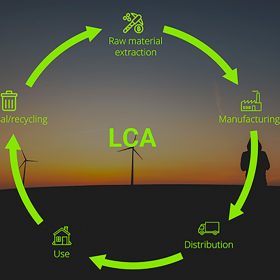
In addition, we help transform your company’s business model to align it with the principles of the circular economy thanks to Life Cycle Assessment (LCA), a tool that allows us to evaluate the environmental impacts of products and services throughout their life cycle. We accompany and guide companies to identify critical points in the value chain, optimize processes, comply with environmental regulations and certifications, and design strategies to enhance the circularity and sustainability of their business. Our approach combines strategy, technique and commitment, so that sustainable practices are profitable and generate value in the medium and long term.
What is the circular economy?
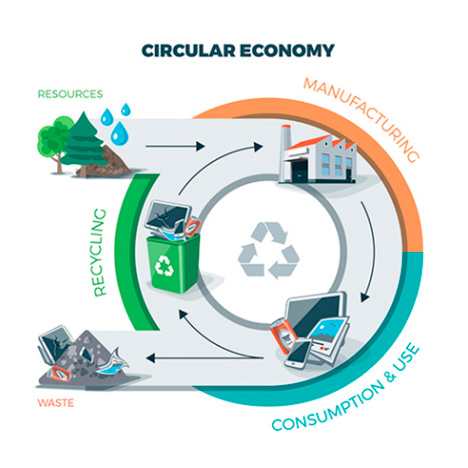
The circular economy is an innovative model of production and consumption that maximizes the value of products and resources, minimizes waste generation and makes the most of waste that cannot be avoided. It is about decoupling economic growth from resource consumption and is also an essential contribution to the European Union’s efforts to achieve a sustainable, decarbonized, efficient and competitive economy. Instead of the linear model (“take-manufacture-consume-dispose”), the circular economy seeks to:
- Reduce and eliminate waste: the objective is to minimize the generation of waste and take advantage of waste whose generation could not be avoided.
- Maintaining the value of products and materials: focuses on extending the useful life of products through reuse, repair and recycling.
- Maximize resource efficiency: redesign products and production processes to use resources (water, energy, materials) more efficiently, reducing the need to extract new raw materials.
- Decoupling economic growth from resource consumption: by transforming “waste” into “resources”, the circular economy allows the economy to grow without depleting finite natural resources.
- Promote the regeneration of natural systems: based on slowing down the use of natural resources, which limits the loss of biodiversity and reduces emissions into the atmosphere, water and soil.
What is Life Cycle Assessment (LCA)?
LCA is an essential tool for sustainability analysis that helps to understand the environmental impact of all products or services. By considering the entire cycle, from the extraction of raw materials to the final disposal of waste, LCA provides a holistic view that helps to identify areas for improvement and to promote more sustainable practices. The results make it possible to identify the contribution of the product or service to, for example, global warming (carbon footprint), atmospheric acidification, water eutrophication, ecotoxicity, water consumption, resource depletion, etc., thus identifying critical points and enabling improvement strategies to be established.
Our method at EHS Techniques
To accompany your company in this transition, our process is structured in 4 phases:
- Definition of circular strategy: We analyze your activities, products and supply chain. We establish measurable and achievable objectives in circular economy, waste reduction, eco-design and resource efficiency.
- Environmental impact assessment through LCA: We carry out complete Life Cycle Assessment studies, environmental product declarations or single indicator studies, such as product carbon footprint or water footprint calculation.
- Action plan to reduce or offset impacts: We design roadmaps that include practical improvements, adoption of low-carbon technologies, process optimization, recycling partnerships, eco-innovation, and compensatory measures when necessary.
- Tracking and monitoring: We implement environmental key performance indicators (KPIs), continuously review objectives to ensure continuous improvement.
Benefits of applying circular economy and LCA
- Legal and regulatory compliance with increasing environmental regulations (EU, Spain).
- Reduction of material, energy and waste costs.
- Improved corporate reputation, responsible image, sustainable differentiation.
- Access to grants, subsidies and public incentives / European funds, related to the ecological transition.
- Mitigation of supply chain risks, dependence on critical raw materials, future market constraints.
Why EHS Techniques?
- Multidisciplinary team with experience in chemical and environmental engineering and European regulations.
- Rigorous studies based on standards and support during the verification process.
- Personalized approach, adapted to the sector (industry, products, services…).
- Transparency and commitment to continuous improvement.
- Experience in the pharmaceutical, manufacturing, food and WWTP sectors.
If you want your company to reduce its environmental impact, optimize resources and prepare for regulatory and market challenges, contact us. With EHS Techniques, the circular economy is not just an aspiration, but a path to real competitiveness and sustainability.
Circular Economy and LCA – Frequently Asked Questions
The circular economy breaks with the traditional model of “extract, produce, consume and dispose” and proposes a system in which products, materials and resources are kept in use for as long as possible.
To incorporate the circular economy in your company and obtain a more circular business model, numerous actions can be carried out such as redesigning products or services, collaborating with sustainable suppliers, obtaining certifications such as zero waste, product environmental declaration, product carbon footprint, etc.
LCA studies, in accordance with ISO 14040, are carried out following these four phases:
- Definition of objectives and scope: Establish what you want to analyze, why and for what purpose. The product system, study boundaries (e.g., cradle to grave), and data quality criteria are defined.
- Inventory analysis (LCI): Data is collected on all flows into and out of the system: raw materials, energy, emissions, waste, transportation, etc. This phase is quantitative and requires a large amount of accurate data.
- Impact assessment (LCIA): The inventory is translated into environmental impacts: climate change, acidification, eutrophication, resource depletion, etc. Impacts are grouped into categories and assessed according to their relevance.
- Interpretation: The results are analyzed to draw useful conclusions. Critical points are identified, improvements are proposed and the reliability of the study is evaluated.
Some of the benefits are:
- Economic savings: reduction of operating costs by reducing dependence on raw materials, reusing materials, optimizing processes, and reducing waste production.
- Reduction of environmental impact: reduction of emissions into the air, water and soil, consumption of non-renewable resources and energy, etc. In addition, we comply with environmental regulations and contribute to climate objectives.
- Innovation: Promotion of innovation in products, processes and circular business models.
- Reputation and loyalty: Improved corporate image by adopting sustainable and responsible practices.
- New business opportunities: Access to green markets, subsidies and sustainable financing o Creation of new lines of income from recovered waste or reconditioned products
Life Cycle Assessment (LCA) Standards
- ISO 14040:2006 Environmental management – Life cycle assessment – Principles and framework: Defines the general principles, methodological framework and system boundaries for conducting an LCA.
- ISO 14044:2006 Environmental management – Life cycle assessment – Requirements and guidelines: Sets out the technical requirements for conducting an LCA, including data collection, impact assessment and validation of results.
Circular Economy Standards
- ISO 59004:2024 Circular economy – Vocabulary, principles and guidance for implementation: Defines key principles and provides guidance for applying the circular economy in organizations.
The circular economy improves industrial sustainability and efficiency by reducing resource consumption, minimizing waste, optimizing processes and fostering technological innovation. This translates into economic savings, reduced environmental impact and greater operational resilience.

Lucía Lijó
lucia.lijo@ehstechniques.com
D. in chemical and environmental engineering
Do you want to move towards a more circular and competitive business model?
Complete the form and our technical team will analyze your case to propose the best solution.