Español

Sustainability and climate change
Specific consulting based on the reality of each client in an increasingly demanding world.
We collaborate in the long-term decarbonization strategy (2050) of large companies, as well as the first steps for smaller corporations.
EHS Techniques manages the carbon footprint of more than 38 corporations and sites.
In addition, we accompany companies that wish to make a real commitment to sustainability and the fight against climate change. Our approach goes beyond regulatory compliance, we help to integrate sustainable principles into the overall business strategy, ensuring that the principles of the fight against climate change provide economic, social and environmental value.
Why Sustainability and Climate Change are key for your company?
Climate change is no longer a future threat: it is impacting supply chains, putting pressure on energy costs, changing national and European regulations, and transforming customer and consumer expectations. In this context, sustainability becomes part of the business strategy:
- Increasingly demanding regulations, both at EU and national level, which implies that companies must make sustainability reports, within their Corporate Social Responsibility(CSR), reflecting their performance in a truthful, transparent and verifiable way, providing an optimization of natural resources and a reduction of GHG emissions.
- Investors and Stakeholders: demand for information from stakeholders on climate risks, minimization of Greenhouse Gas (GHG) emissions, Carbon Footprint Management, etc.
- Innovation and efficiency opportunities: related to energy efficiency, rational use of resources, renewable energies and a more resilient supply chain, among others.
- Corporate and reputational image: consumers and society increasingly appreciate companies that act responsibly towards the environment.
What services do we offer in Sustainability / Climate Change?
EHS Techniques designs customized solutions for each client’s specific needs. Our services include:
- Sustainability reporting and ESG reporting
- We advise on the preparation of non-financial reports (EINF) and Sustainability Reports in accordance with the applicable national and European legislation (Law 11/2018 and CSRD), and international standards such as GRI.
- Carbon footprint management:
- We establish the most appropriate strategy for each client to achieve a reduction of its carbon footprint in the short, medium and long term.
- We conducted the GHG Emissions Inventory.
- We calculate direct and indirect emissions (scope 1, 2 and 3), to identify reduction and/or compensation actions.
- Decarbonization and Net Zero Strategic Plans
- We help develop Net Zero strategies that integrate clear targets, realistic decarbonization plans, energy transition, energy efficiency, renewable energy use and verified offsets.
- Taxonomy: Climate risk assessment and adaptation
- We identify physical, regulatory and climate transition risks, assess their impact on the company, and design resilience and adaptation plans.
- Training, organizational culture and internal awareness
- Policies are not enough: we work with employees, managers, suppliers to generate a culture of sustainability, encourage key behaviors, integrate climate change into daily decision making.
Benefits of Sustainability and Climate Change Reporting with the help of EHS Techniques
- Advanced regulatory compliance: ensure that your company is aligned with EU, Spanish and international regulations and standards required by customers or investors.
- Optimization of operating costs by establishing energy efficiency plans and lower resource consumption.
- Mitigation of financial and reputational risks: Avoiding sanctions and fines for non-compliance with environmental or social regulations.
- Access to green finance, responsible investments, subsidies and grants for ecological transition, energy efficiency and climate adaptability by improving ESG (environmental, social and governance) ratings, facilitating access to green loans or responsible investments.
- Improved competitiveness and differentiation: a company aligned with climate objectives has an advantage in obtaining contracts, tenders, public image.
How do we work?
Our process is collaborative, transparent and data-driven:
- Exhaustive initial diagnosis: analysis of current status, emissions, resources, operating processes.
- Definition of SMART (Specific, Measurable, Achievable, Relevant, Time-bound) objectives in Sustainability and Climate Change.
- Customized action plan including mitigation, adaptation and eco-innovation measures.
- Use of internationally recognized software (Carbon+Alt+Delete and Simapro/Ecoinvent).
- Continuous monitoring and adjustment: key indicators (KPIs), periodic reports, continuous improvement.
- Support in external Verification and Certification processes, providing greater credibility and solvency to our reports.
If your company, as part of its sustainability strategy, wants to anticipate future challenges, avoid risks, and participate in minimizing the impact of emissions on climate change and turn this performance into a competitive advantage, contact us. At EHS Techniques, we are ready to draw together your roadmap towards real, resilient and profitable Sustainability.
Sustainability and Climate Change – Frequently Asked Questions
Your company can implement a wide range of measures to mitigate climate change, depending on your industry, resources and influence.
- Operational changes, e.g. energy efficiency, renewable energy procurement, waste reduction.
- Strategic initiatives, e.g.: Carbon accounting (Scope 1, 2 and 3 emissions measurement and science-based target setting), Climate risk assessment, Employee engagement.
- Collaboration and advocacy, e.g.: Supply chain engagement, Policy support, Promotion of climate-friendly regulations and incentives, Transparency through progress reporting through CDP, TCFD or other regulatory frameworks.
EHS Techniques can be a key partner in helping your company identify and achieve its sustainability and ESG (environmental, social and governance) objectives through:
- Climate change assessment and climate change strategy development
- Dual materiality assessment: Identify the ESG aspects that are most important for your stakeholders and your business.
- Target setting: help define measurable sustainability targets aligned with global frameworks (e.g., CSRD, RD 11/2018, SDGs, SBTi, GHG Protocol).
To monitor ESG (environmental, social and governance) performance, companies should use various quantitative and qualitative indicators. These indicators help to assess the risks, opportunities and impacts of sustainability on their operations, supply chain and stakeholder relationships. We can differentiate between
Environmental indicators: Carbon emissions (Scope 1, 2 and 3 greenhouse gas emissions), energy consumption, water consumption, waste management and impact on biodiversity, among others.
Social indicators: Diversity and inclusion (gender, age and ethnic diversity in all roles), employee well-being, regulatory compliance and labor practices, community engagement, customer satisfaction, human rights, among others.
Integrating sustainability into a company’s industrial or energy processes involves rethinking how resources are used, how emissions are managed and how operations can be aligned with environmental and social objectives.
Adopting sustainability strategies can bring significant economic and reputational benefits to your company, such as:
- Economic benefits: Cost savings, access to financing and incentives. Governments and institutions offer grants, tax exemptions, public tenders and subsidies for green initiatives. In addition, sustainable companies are more attractive to ESG-focused investors and lenders, reduce risk, and drive product and process innovation, among others.
- Reputational benefits: Brand differentiation, talent attraction and retention, among others.
- Stakeholder confidence: Transparent ESG practices foster the confidence of investors, regulators and communities, and enhance credibility in public tenders and collaborations.
- Media and recognition: Achievements in sustainability can result in awards, certifications and positive media coverage.
Managing your company’s carbon footprint involves taking a structured approach to measuring, reducing and offsetting greenhouse gas (GHG) emissions.
EHS Techniques can help you establish a strategy to manage your carbon footprint by providing highly qualified personnel and internationally certified software tools (e.g. Carbon+ alt+ delete software specially designed for sustainability consultants, Simapro and Ecoinvent) that allow you to benefit from the latest technological advances without having to purchase them on a company-wide basis.
You must measure all greenhouse gas emissions produced as a result of your business activity.
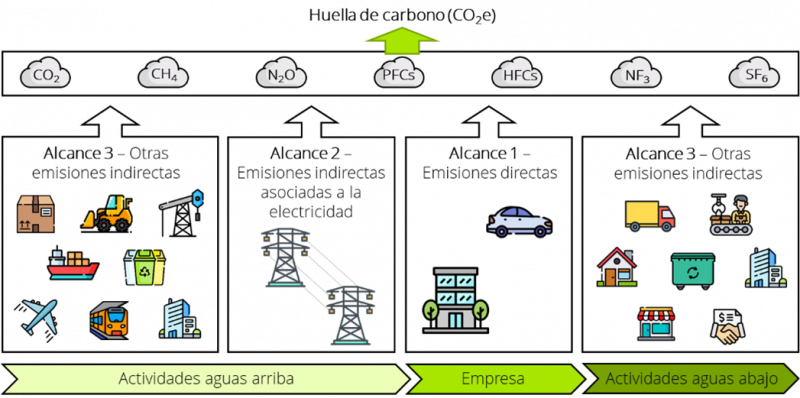
EHS Techniques can assist you in this regard by providing you with highly qualified personnel and the latest technological advances for the automated calculation of your carbon footprint.
In order to monitor a company’s carbon footprint, GHG emissions must be tracked in all its operations, supply chain and products. To do this, ratios should be established that allow us to evaluate our climate change performance in terms of the company’s evolution, such as:
R1: Corporate GHG emissions (Scopes 1, 2 and 3) / EBITDA
R2: Corporate GHG emissions (Scope 1, 2 and 3) / Hours worked
R3: Corporate GHG emissions (Scopes 1, 2 and 3) / Number of employees
Reducing a company’s carbon footprint involves considering a combination of strategic planning, operational changes and stakeholder involvement.
EHS Techniques can help you develop a GHG Emission Reduction Plan for the short, medium and long term depending on the means available. We can also develop an offset plan proposal that will allow you to achieve your long-term goals.

Laura de Eugenio
laura.deeugenio@ehstechniques.com
Case Studies


Do you want to reduce your emissions and move towards a more sustainable model?
Complete the form and our technical team will analyze your case to propose the best solution