
 Español

Authors: Ruth López, Amanda Pérez, Raquel Carrasco | Consultants on EHS Techniques
If you want our team to develop the Social Risk Studies, meeting expectations, with an investment adjusted to your needs, click here, and let’s start together
The Energy Transition will be fair or it won’t be, a message full of connotations and open to interpretations depending on the “place” from which the premise is launched.
The implementation of renewable energy projects in the territory does not only generate benefits from a global environmental perspective. It also introduces social, economic and territorial changes which, if not properly analysed and managed, can become real risks for the development of the project.
In recent years, numerous renewable projects in Spain have been delayed in processing, blocked in their implementation or deteriorated in their social acceptance not for technical or environmental reasons, but because of social risks not identified in time.
This context shows that the energy transition cannot be approached solely from a technological or regulatory perspective, but requires a rigorous territorial and social reading.
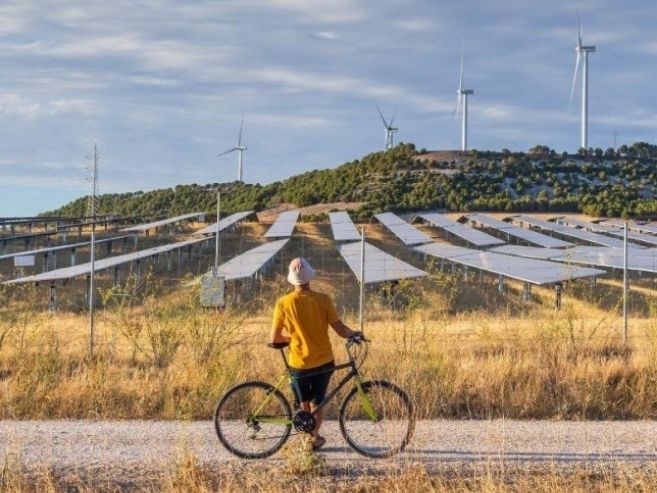
Analyze the risk to build viable projects in the territory
Let us take the example of a photovoltaic installation in a municipality affected by the demographic challenge.
The project alone is expected to contribute to boosting the local economy, generating employment and increasing municipal income, with a positive impact on the quality of life of residents. At the same time, it will contribute to the country’s major strategic goals of decarbonization and energy efficiency.
However, at the local level, the project can accelerate pre-existing territorial dynamics. In a previous territorial analysis, a high risk of displacement of traditional agricultural activity can be detected, associated with the lack of generational change and the guarantee of stable incomes offered by the energy project compared to the primary sector.
The assessment of this risk makes it possible to define specific mitigation measures, such as the launching of actions for the professionalization of the primary sector, the creation of an exchange of arable land, the development of awareness campaigns or the promotion of primary activity through incentives aimed at local promoters.
When these measures arise from the territorial discourse itself and are developed through participatory processes, based on a close dialogue with citizens and local authorities, the result can be a renewable energy project aligned with the global objectives and, at the same time, focused on generating positive territorial impact. In short, a Just Energy Transition project.
On the contrary, bypassing the analysis of this risk can accelerate in the medium and long term the abandonment of agricultural activity, deteriorate the local perception of the project and become a relevant reputational risk for the promoter company.
Social risks: specific, changing and territorial
This example illustrates that social risks are neither homogeneous nor abstract. In renewable energy projects, the typology of associated risks is very diverse and depends on many factors: the technology used, the location of the project, the social characteristics of the territory, the existing economic dynamics or even the current political and sectoral situation.
Therefore, establishing a closed classification of social risks is limited. Each project is unique and, consequently, so are the impacts it can generate on the territory and the recipient communities.
The analysis should always be carried out on a case-by-case basis, integrating the territorial perspective from the early stages of development.
As an operational reference, a social risk matrix can help to identify and anticipate the main sources of conflict:
| Category of social risk | Risk description | Strategic impact |
| Conflict over land use | Competition with primary sector, tourism or traditional uses | Social and administrative blockade |
| Social rejection and negative perception | Neighbourhood opposition, local platforms, NIMBY and NIMTO movements | Delays, pleadings, litigation |
| Unequal distribution of benefits | Perception that the project does not generate local value | Loss of social acceptance |
| Impact on lifestyle | Allocation to existing economic activities | Sectarian clashes |
| Absence of social relationships | Lack of dialogue with social partners | Conflict escalation |
| Impacts during construction | Noise, traffic, dust, nuisance | Interruption of the works |
| Unmanaged social expectations | Implicit or mismanaged promises | Recurrent frustration and conflicts |
| Long term social leave | Progressive deterioration of social acceptance | NIMTO risk – by political pressure |
This matrix does not replace the specific analysis, but it guides the early identification of risks that, if not managed, can compromise the viability of the project.
Regulatory framework: a growing demand, not just good practice
The analysis of social and territorial impacts takes place in an increasingly demanding normative context. Law 7/2021 on Climate Change and Energy Transition incorporates the principle of fair transition, while Law 21/2013 on Environmental Assessment reinforces the need to integrate the social dimension into decision-making.
Other regional standards form the reference regulatory framework, to which are added ESG standards, sustainable financing requirements and expectations of investors and public administrations.
In this scenario, social risk analysis ceases to be a voluntary action and becomes a strategic project management tool.
Social risk analysis as a competitive advantage
Carrying out an early risk analysis from a social perspective allows to improve the design of the project, anticipate conflicts, align the social benefits with the expectations of the territory and promote social acceptance.
In addition, it contributes to a more efficient management of administrative deadlines, reduces exposure to reputational risks and strengthens the ESG positioning of sponsoring companies.
At EHS Techniques we understand social risk analysis as a key lever for the responsible development of energy projects.
We support promoters and funders in the early identification of impacts, the design of territorial strategies and the construction of relationships of trust with local communities, integrating the social dimension as an essential part of the project’s viability.
Why choose EHS Techniques as a sustainability and climate change consultant?
- More than 10 years of expertise working with large and medium-sized enterprises in sectors such as energy, food or tourism.
- Ability to offer specific and tailored solutions for each organisation.
- Real integration into customer teams, working as part of the company.
- A human team with high technical expertise and practical vision.
The EHS Techniques team guarantees a close and flexible service, adapted to each client’s needs, combining technical rigor with the implementation of advanced solutions at reasonable costs.
Contact with our professional team.
International experience
We have the international experience to continue offering this service to continue offering this service anywhere in the world.