
 Español

One of our clients operates two power generation plants, both located in Andalusia, where energy is generated by burning biomass, primarily olive grove waste such as olive pomace.
Heavy rainfall between late 2025 and early 2026, particularly in January, meant that the water storage capacity for water that had been in contact with the biomass storage facility’s stockpiles was nearing its limit. Consequently, EHS Techniques was commissioned to carry out an urgent study to assess the potential impact of a controlled discharge of this water on the riverine environment.
Compliance with Regulations
Directive 2004/35/EC on environmental liability, transposed into Spanish law by Law 26/2007 on Environmental Liability, sets out the regulatory framework for environmental damage, based on the principles of prevention and the obligation for the party responsible to bear the costs arising from pollution.
However, this legislation provides for certain exceptions. Specifically, Article 3(4) stipulates that it shall not apply in cases where environmental damage, or the risk of such damage occurring, arises from specific causes, including natural phenomena of an exceptional, inevitable and irresistible nature. In this regard, the current debate on what can be considered an exceptional phenomenon today is particularly relevant, especially in the context of climate change.
Furthermore, as this is an emergency situation at an industrial facility, the provisions of Law 2/2002 on Emergency Management in Andalusia have also been taken into account, as well as the Andalusian Civil Protection Territorial Emergency Plan (PTEAnd).
Preliminary study of the landfill
Before reaching a decision, the characteristics of the stored water and the environment where the discharge might occur—both upstream and downstream—were analysed. The potential risks to the natural environment were also assessed.
Using this information, together with data on rainfall, river flows and water analyses—both of the effluent and the receiving environment—a simulation was carried out to predict what would happen if the discharge were to take place. To do this, an indicator known as BOD5 was used, which measures the amount of oxygen required by microorganisms to break down organic matter in the water. This data is important because it affects the life of aquatic organisms.
Using specialised software (IBER), a model was created to simulate how the spill would disperse in the river. This made it possible to assess whether the spill could affect the ecosystem.
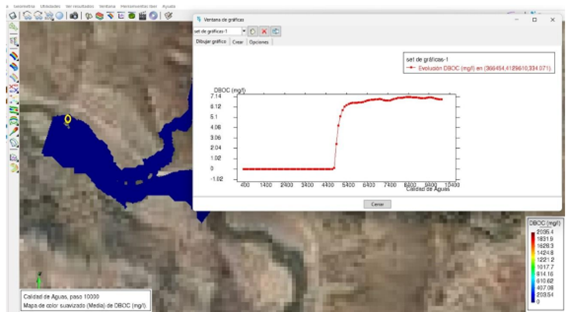
Figure 1: Example of modelling the BOD₅ plume as it reaches one of the watercourses.
Implementation and Monitoring of the Discharge
The results showed that the discharge would be sufficiently diluted not to cause any damage to the environment. Consequently, it was carried out in a controlled manner, with the volume of water discharged adjusted in line with the study’s findings.
Throughout the process, a number of measures were taken:
- The relevant authority was notified.
- A specific action plan for this type of situation was implemented.
- Specialist technicians were on hand to supervise the operation.
- Water quality was monitored at various points along the river, including unaffected areas for comparison.
- Support was provided by a company specialising in environmental emergencies.
Conclusions
Thanks to the rapid assessment and prior simulation, sound decisions were made that prevented damage to the environment. Furthermore, control measures for similar situations were strengthened.
Finally, it was found that the river had an even greater dilution capacity than expected. Both the analyses and the field observations confirmed that there were no adverse effects on the environment.
As a result, the incident was resolved without any environmental consequences.
Why choose EHS Techniques as your environmental consultant?
- More than 10 years of expertise working with large and medium-sized enterprises in sectors such as energy, food or tourism.
- Ability to offer specific and tailored solutions for each organisation.
- Real integration into customer teams, working as part of the company.
- A human team with high technical expertise and practical vision.
The EHS Techniques team guarantees a close and flexible service, adapted to each client’s needs, combining technical rigor with the implementation of advanced solutions at reasonable costs.
Contact our team of professionals.
International experience
We have the international experience to continue offering this service to continue offering this service anywhere in the world.