Español

Efficiency, emissions and noise
Our specialists offer the best available techniques for each case.
Specialized in modeling for the design of new facilities, as well as in the inventory of sources.
EHS Techniques provides companies and public agencies with a team of specialists in energy efficiency, air emissions and noise pollution, with technical, regulatory and practical experience to optimize their environmental performance, reduce operating costs and ensure regulatory compliance. Our commitment is to help you achieve cleaner, quieter and more efficient operations.
What services do we offer in Emissions, Noise and Efficiency?
Our services cover key areas for your company to control emissions, minimize noise pollution, optimize energy consumption and adapt to regulatory standards:
- Energy Audits
We perform mandatory energy audits for companies subject to Royal Decree 56/2016 (transposition of Directive 2012/27/EU). This includes the analysis of consumption, efficiency in processes, identifying energy saving opportunities, monitoring, establishment of indicators, continuous improvement, as well as the implementation of energy management systems in accordance with ISO 50001. We also carry out studies with standards such as BREEAM, LEED, WELL, for projects that require sustainability certifications. - Technical Assistance Atmosphere
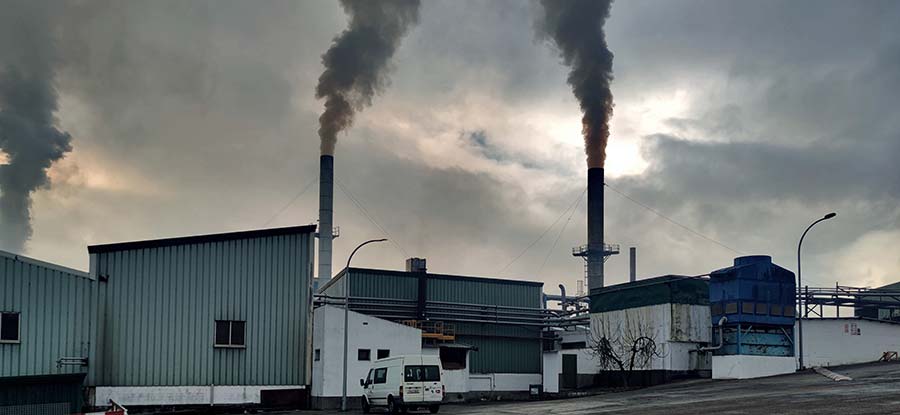
We help companies and public bodies to understand the legal requirements regarding the atmosphere: processing of authorizations, large combustion installations, automatic measurement systems, preparation of E-PRTR reports, calculation of chimney heights, drafting of environmental reports and adaptation to regulatory changes that regulate atmospheric pollutants. - Noise Studies and Acoustic Solutions
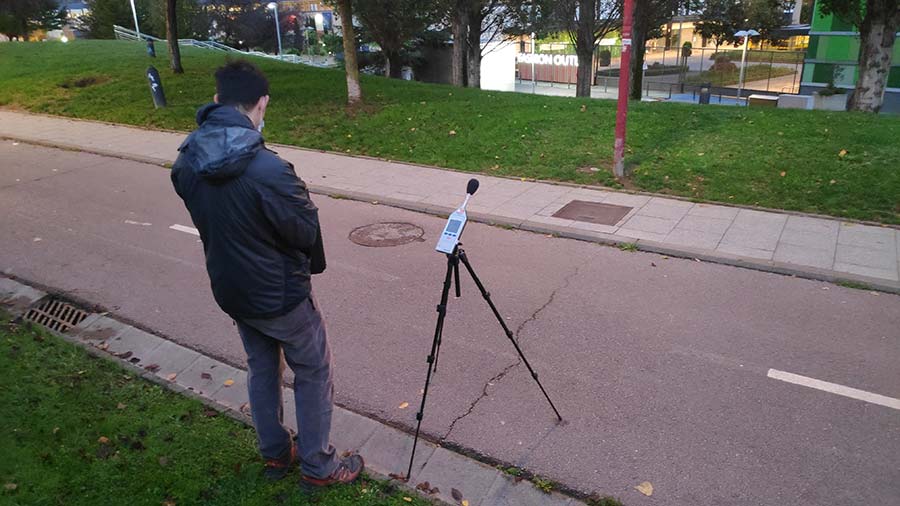
Noise is one of the most common pollutants: we study and evaluate noise levels emitted by facilities, infrastructures or activities, through noise impact studies, noise maps, acoustic modeling, insulation or barriers to reduce sound propagation. We also advise in tenders and in compliance with local ordinances and regulations, as well as in the design of corrective measures when the levels exceed the permitted limits. - Monitoring, reporting and regulatory compliance
We perform continuous monitoring, auditable reports, technical support in relations with public administrations. We assist you in keeping your facilities within legal limits, adapting when municipal ordinances, regional laws or European directives change. - Training and specialized advice
We offer training for technical personnel, maintenance managers, managers, on best practices, available technologies, measurement procedures, interpretation of results, implementation of corrective measures, acoustic mitigation, etc.
Benefits of working with EHS Techniques on Emissions and Noise
- Reduced operating costs through improved energy efficiency, lower fuel consumption, optimization of equipment and processes.
- Improved legal compliance, avoiding administrative sanctions, fines or conflicts with local or environmental authorities.
- Minimization of environmental and acoustic impact, contributing to the well-being of workers and nearby communities.
- Improved reputation and social license, especially in noise-sensitive industries or those located near residential areas.
- Increased competitiveness through certifications, good environmental practices and efficiency, which can open markets or facilitate bidding processes.
If your company wants to optimize consumption, reduce emissions and noise, comply with current regulations and improve its environmental performance, contact us. At EHS Techniques we are prepared to offer you accurate diagnostics, robust technical solutions and continuous support to make your operations more efficient, cleaner and quieter.
Efficiency, emissions, noise – Frequently asked questions
The regulations governing atmospheric emissions and industrial noise in Spain are complex and are scattered in several laws and regulations, as they address different aspects
Atmospheric Emissions (Industrial Pollution)
The main regulation focuses on Integrated Pollution Prevention and Control (IPPC), which includes air emissions:
- Law 16/2002, of July 1, 2002, on integrated pollution prevention and control (amended and updated). This law establishes the framework for the Integrated Environmental Authorization (AAI), which includes air emission limits for large industries.
- Royal Decree 815/2013, of October 18, which approves the Regulation on industrial emissions and development of Law 16/2002. This regulation develops and specifies the control requirements and emission limit values of pollutants into the atmosphere for industrial facilities.
In addition, there are specific regulations on air quality and specific pollutants:
- Law 34/2007, of November 15, 2007, on air quality and atmospheric protection. It establishes the legal regime for the prevention, monitoring and reduction of atmospheric pollution, including the establishment of air quality objectives.
- Royal Decree 1042/2017, of December 22, on the limitation of emissions into the atmosphere of certain pollutants from medium combustion facilities and updating Annex IV of Law 34/2007, of November 15, on air quality and protection of the atmosphere.
- Royal Decree 117 2003 of January 31, 2003, on the limitation of emissions of volatile organic compounds due to the use of solvents in certain activities.
- Royal Decree 102/2011, of January 28, on the improvement of air quality.
Industrial Noise
The basic noise regulations, which affect industrial noise in the environment, are:
- Law 37/2003, of November 17, 2003, on Noise. It is the fundamental regulation that establishes the concepts, the scope of application and the distribution of competences.
- Royal Decree 1367/2007, of October 19, 2007, which develops Law 37/2003, regarding acoustic zoning, quality objectives and acoustic emissions. This is crucial because it establishes noise emission limits for industrial activities depending on the zone where they are located.
In Spain, the Autonomous Communities and Municipalities have competences and develop their own regulations, which must be consistent with state legislation, and may even be more demanding in their respective territories. Therefore, for a specific installation, it is necessary to consult the applicable autonomous community and municipal regulations.
The Noise Impact Study focuses on a specific activity or facility to assess its impact on nearby receptors, while the Noise Map analyzes large geographic areas to plan environmental management.
- The Acoustic Impact Study is a mandatory technical document to obtain the opening or environmental license for an activity (industrial, recreational, etc.) and focuses on compliance with noise emission and immission limits. For its realization, an analysis of the legislation and the environment is carried out, we identify and characterize the noise sources and the propagation of noise is modeled by means of acoustic prediction software obtaining predicted noise levels that are evaluated and conclusions are drawn.
- Noise Maps are territorial planning tools to assess and manage environmental noise in urban agglomerations or near large infrastructures (roads, railroads, airports). Their preparation requires the collection of geographic and traffic data, large scale modeling, generation of acoustic cartography, analysis of exposed population and elaboration of action plans.
There are various actions and strategies that industrial facilities can implement to reduce both air emissions and noise. Measures are usually classified according to whether they act on the source, on the propagation medium or on the receptor.
The main focus is the application of BAT or Best Available Techniques, as required by European and Spanish legislation.
We will act at the source: improving energy and process efficiency and substituting raw materials for more sustainable alternatives.
We will act at the receptors: installing corrective measures such as treatment systems.
Improving energy efficiency and reducing emissions in industrial facilities brings a number of crucial benefits such as:
Economic and operational benefits: reduced operating costs, increased profitability and competitiveness, return on investment, financial incentives and reduced regulatory risks.
Environmental and climate benefits: the reduction of emissions has a direct and positive impact on the fight against climate change and on the quality of the local environment.
Health and social welfare benefits with direct effects on the health of workers and the surrounding population,
Image and reputational benefits that provide a competitive advantage, attract investment and enhance brand image.

Antonio Cañas
antonio.canas@ehstechniques.com
Case Studies
You want to optimize your installation and reduce its environmental impact in a cost-effective way?
Complete the form and our technical team will evaluate your case to propose the most suitable solution.