
 Español

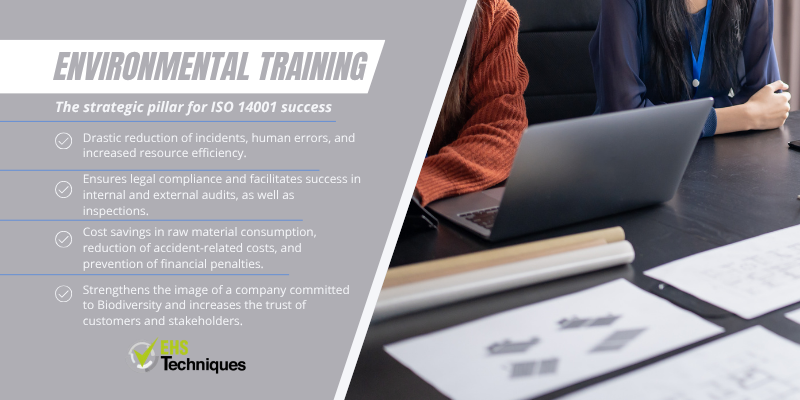
Is training just a paperwork formality or a shield against legal and operational risks?
In an increasingly regulated business environment, having a management manual is no longer enough; organizations need their teams to know what to do, how to do it, and why it is vital. In this context, ISO 14001 (Environmental Management) and ISO 45001 (Occupational Health and Safety) standards require individuals to have the proper competence to protect both the environment and workplace safety.
Training and awareness are not just requirements: they are the engine of continuous improvement.
Key ISO 14001 requirements
The standard is clear: everyone under the organization’s control must understand their role within the system. Poor training is a direct path toward operational errors, sanctions, or non-conformities during audits.
To avoid this, personnel must have a thorough understanding of:
The Environmental Policy: The company’s real commitment.
Aspects and impacts: Which activities can damage the environment.
Contribution to success: The actual benefits of improving environmental performance.
Risks of non-compliance: The legal and operational implications of not following procedures.
Essential content: Beyond the standard
A robust environmental training program must integrate applicable legal requirements, linking environmental management with technical safety. Essential content includes:
- Waste management: Treatment, storage, and regulations.
- Environmental vectors: Control of atmospheric emissions, discharges, and noise.
- Sustancias peligrosas: Manipulación segura y almacenamiento químico.
- Emergency response: Critical instructions for fires, spills, or leaks.
- Facilities: Electrical and technical maintenance with environmental impact.
Planning: The secret to effectiveness
For training to be useful, it cannot be generic. It must be planned by profile, documented, and, above all, periodically evaluated. This is the only way to ensure that every worker understands their responsibilities and acts in accordance with the procedures.
Benefits of investing in Environmental Training
- Operational: Drastic reduction in incidents and human errors, and greater efficiency in the use of resources.
- Regulatory: Ensures legal compliance and facilitates success in internal and external audits, as well as inspections.
- Economic: Savings in raw material consumption, reduction of costs due to accidents, and prevention of financial penalties.
- Reputational: Strengthens the image of a company committed to Biodiversity and increases the trust of customers and stakeholders.
Environmental training is not an expense, it is an investment in resilience. At EHS Techniques, we don’t just help you comply with the standard: we transform your company culture so that sustainability becomes a real competitive advantage.
Is your team ready for the next environmental challenge? We accompany you throughout the process.
Why choose EHS Techniques as your environmental consultant?
- More than 10 years of expertise working with large and medium-sized enterprises in sectors such as energy, food or tourism.
- Ability to offer specific and tailored solutions for each organisation.
- Real integration into customer teams, working as part of the company.
- A human team with high technical expertise and practical vision.
The EHS Techniques team guarantees a close and flexible service, adapted to each client’s needs, combining technical rigor with the implementation of advanced solutions at reasonable costs.
Contact our team of professionals.
International experience
We have the international experience to continue offering this service to continue offering this service anywhere in the world.