
 Español


When developing a new energy or industrial project—whether it is a renewable gas plant, photovoltaic, wind, an energy storage system, or even data centers—choosing the right location is one of the first challenges.
Identifying a plot with a good location or a viable grid connection is not enough. If the land presents insurmountable legal, environmental, or social restrictions, the project can grind to a halt months later, causing significant financial losses.
EHS Techniques’ Pre-feasibility Studies act as a safety filter. Their objective is to evaluate the specific plots identified by the client to detect “red lines” and determine the suitability of the land before making financial investments in detailed engineering.
The cost of not looking before you leap: Why every technology is at stake over a different “red line”
In the development sector, there are no one-size-fits-all solutions. Each technology faces its own territorial “Achilles’ heel.” What might be a simple procedure for a photovoltaic park can be an insurmountable wall for a data center or a biomethane plant.
If we look at the project map in Spain, the reasons why an investment stalls vary depending on the typology:
- Biomethane Plants (The social battle and setbacks): Imagine finding an apparently ideal rustic plot—flat, strategically located close to raw materials, and accessible. However, if a local-scale analysis is not conducted, and the project is planned right on a tourist or cultural route, or in a scattered settlement zone, the result is clear: headlines in the local press, an opposition neighborhood platform, and a city council blocking licenses out of fear of odors and other local impacts. In this case, social pre-feasibility can be the tool that saves the investment.
- Data Centers (The water and energy labyrinth): The land is chosen and the urban planning viability seems clear. However, a data center is not just any industrial warehouse. Its high demand for cooling and power can clash head-on with water vulnerability zones or severe grid restrictions. Detecting these sector-specific conditions in time avoids acquiring a plot of land where, technically, a server will never be able to be turned on.
- Photovoltaic and Wind Projects (Usable land and birdlife): This is the classic miscalculation. Drawing a polygon of hundreds of hectares on the office map that, after the desk-based environmental analysis and the field visit, is cut in half. Why? Due to overlaps with a bird migration corridor (IBA), a livestock trail, or a flood zone associated with a small stream that was not accurately mapped on general charts. Environmental pre-feasibility defines here the real size (and profitability) of the business.
- Energy Storage Systems / Batteries (Pure urban planning fit): Batteries are the newcomers to the board. Many municipal planning schemes do not even contemplate them in their urban regulations. Locating a storage system requires fine-tuning with regional regulations, land-use plans, and urban planning to ensure that the land classification allows this specific use before starting a lengthy permitting process.
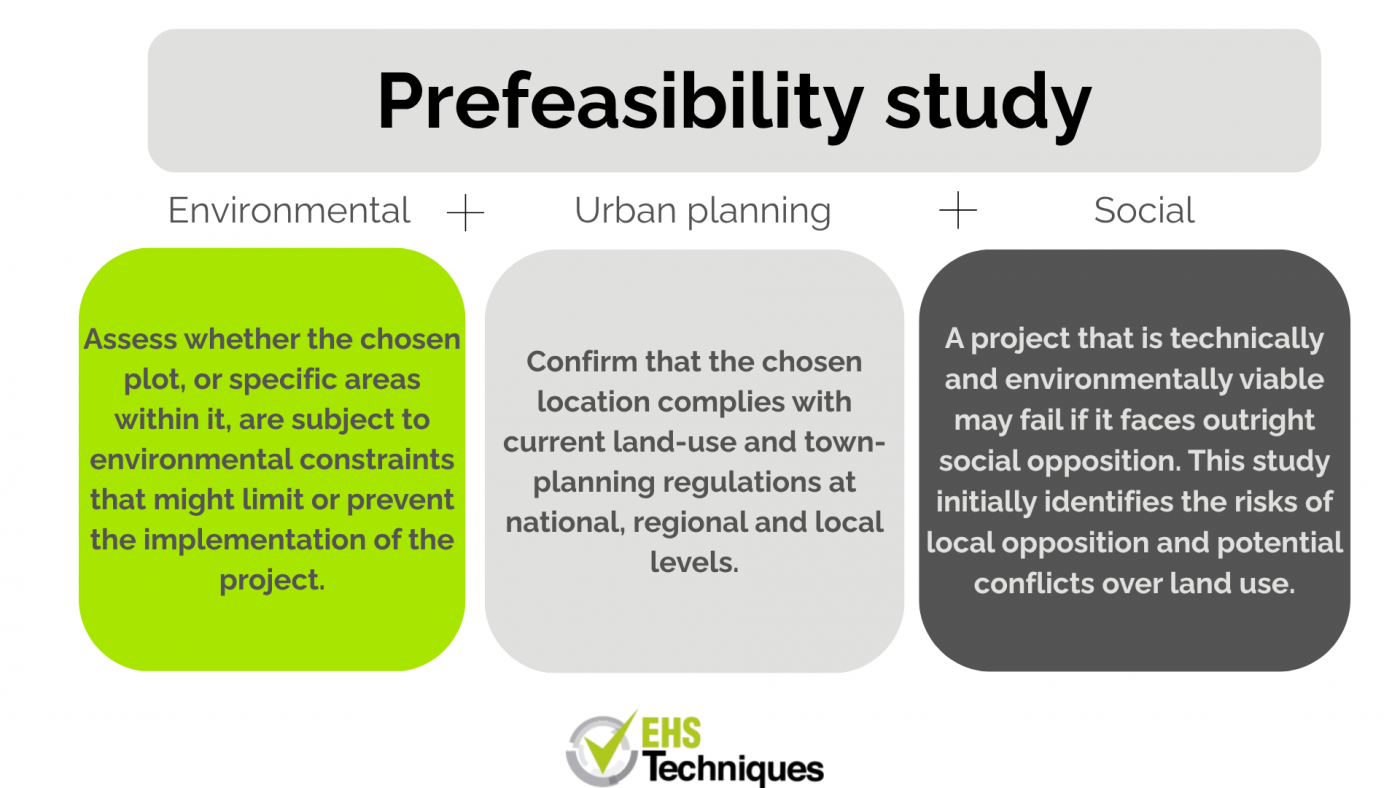
Informes de prefactibilidad que dan respuesta a necesidades concretas.
Prefeasibility reports that respond to specific needs
This analysis evaluates whether the chosen plot, or which specific areas within it, present environmental constraints that limit or prevent the implementation of the project.
✔ Urban Planning Pre-feasibility: Alignment with the legal and territorial framework
The objective is to confirm the legal compatibility of the chosen location with the current land-use and urban planning regulations at the state, regional, and municipal levels.
✔ Social Pre-feasibility: Evaluation of the territory’s carrying capacity
A technically and environmentally viable project can fail if it faces outright social rejection. This study initially identifies the risks of local opposition and potential conflicts over land use.
The differential value of EHS Techniques: Real data on the ground
To ensure maximum rigor, at EHS Techniques we recommend complementing the desk-based work with a field visit. This on-site day allows us to confirm bibliographic data, corroborate assumptions on the ground, and realistically adjust the project’s perimeters.
We do not deliver endless and complex reports. We design a document with a format that allows for an agile and easily understood reading, specifically structured to facilitate strategic decision-making for developers and development directors.
Are you identifying land for your next project? Avoid unexpected risks and ensure the viability of your investment from the very beginning.
Let’s talk about your project—contact us today.